


There was a time when the heart of Nigerian sports beat strongest not on a football pitch, but on the tartan tracks of the National Stadium, Surulere. In the 1990s, a golden generation of athletes transformed track and field into the nation’s most captivating spectacle. The annual Mobil Track and Field Championships was the crucible where legends were forged, and its grand finale, the 100-meter dash, was the hottest ticket in town.
To be in Surulere on the day of the 100m finals was to witness an event that transcended sport. The stadium, a sprawling concrete bowl, would heave and roar, filled to its very capacity with fans who came to see raw speed and fierce rivalries. The air crackled with anticipation. This was more than just a race; it was a coronation. Who would be crowned the fastest man and woman in Nigeria? The answer to that question felt like a matter of national importance, and the explosion of sound that greeted the starter’s pistol was a testament to a nation utterly captivated by its athletic heroes.
The Local Proving Ground: Mobil Championships
The Mobil Championships were the bedrock of this golden age. It was here that rivalries were born and cemented. The men’s 100m was a gladiatorial contest, often featuring the formidable Ezinwa brothers, Davidson and Osmond. Their power and explosive starts were a sight to behold. They were pushed to their limits by the elegant and powerful strides of Olapade Adeniken and the raw talent of Chidi Imoh. To win the Mobil 100m was to earn your stripes and the right to wear the green and white on the global stage.
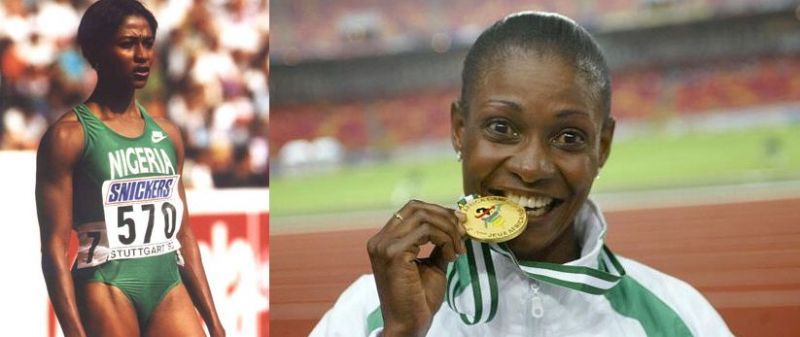
The women’s final was no less intense. It was the domain of the queen of Nigerian track, Mary Onyali. Her grace and fierce determination made her a national icon. But she was always challenged by a galaxy of stars, including the brilliant Falilat Ogunkoya, Beatrice Utondu, and Christy Opara-Thompson. These women were not just competing against each other; they were pushing the boundaries of what was thought possible, and the packed stands of Surulere were their witness.
Taking on the World: Cairo, Barcelona, and Atlanta
This fire, forged in the heat of Lagos, was soon unleashed upon the world. The 1991 All-Africa Games in Cairo was a declaration of intent. Nigeria dominated the athletics events. Mary Onyali clinched the 100m gold, leading a Nigerian sweep of the podium. Fatima Yusuf, another prodigious talent, announced her arrival by winning the 400m. The men’s 4x100m relay team, a seamless blend of speed and precision, also stormed to victory, setting the stage for what was to come.
Then came the 1992 Barcelona Olympics. The world watched as Nigeria’s relay teams etched their names into history. The men’s 4x100m team of Oluyemi Kayode, Chidi Imoh, Olapade Adeniken, and Davidson Ezinwa ran a blistering race. In an era dominated by the Americans, led by the legendary Carl Lewis, the Nigerian quartet flew around the track to claim a coveted silver medal, their fluid baton changes a thing of beauty.
Not to be outdone, the women’s 4x100m team of Beatrice Utondu, Faith Idehen, Christy Opara-Thompson, and Mary Onyali provided one of the most iconic moments of the Games. They seized the bronze medal, and their unbridled, joyous celebration upon seeing the result on the stadium screen captured the hearts of millions globally. It was a pure, unfiltered expression of what it meant to achieve an Olympic dream.
The momentum carried through to the 1996 Atlanta Olympics. This was the stage for individual brilliance. The phenomenal Falilat Ogunkoya, who had been a dominant force for years, finally won her individual Olympic medal. In a stacked 400m final, she ran the race of her life to claim the bronze medal in an African record time of 49.10 seconds that still stands as one of the fastest in history. The race was won by France’s Marie-José Pérec, with Australia’s Cathy Freeman taking silver, placing Ogunkoya in truly elite company.
Mary Onyali, the ever-present queen, also secured her individual glory, winning a hard-fought bronze in the 200 meters. But the crowning achievement in Atlanta was arguably the women’s 4x400m relay. The team of Bisi Afolabi, Fatima Yusuf, Charity Opara, and Falilat Ogunkoya ran a masterful race to win the silver medal, battling against the world’s best and proving Nigeria’s depth in the long sprints. They were only beaten by an American team anchored by the great Michael Johnson, the era’s most dominant 400m runner, who achieved legendary status at those games by winning both the 200m and 400m.
A Legacy of Legends
The roll call of names from this era is a pantheon of Nigerian sporting greatness. Beyond those already mentioned, there was the indomitable Sunday Bada, a 400m powerhouse and a vital cog in the men’s 4x400m relay teams that won world and Olympic medals. There was Innocent Egbunike, a trailblazer from the 80s whose success in the 400m laid the groundwork for the stars of the 90s. The list goes on: Charity Opara, Clement Chukwu, Francis Obikwelu, who started his illustrious career in Nigerian colours.
These athletes did more than win medals. In a period of social and political uncertainty, they were a source of immense national pride. They were a reminder of Nigeria’s potential for greatness. The roar that once filled the National Stadium in Surulere may have faded, but the memories of those glorious days on the track, and the legends they produced, will endure forever. They set a standard of excellence that continues to inspire a new generation of Nigerian athletes, who dream of one day recreating that golden era.


One thought on “The Roar of Surulere: Remembering Nigeria’s Golden Era of Athletics”