




A Ship Without a Rudder: Manchester United’s Descent into Crisis
The deafening silence following the final whistle at Blundell Park spoke volumes. A club of Manchester United’s stature, with its rich history and global prestige, has been unceremoniously dumped out of the Carabao Cup by a League Two side. This isn’t just an embarrassing defeat; it’s a scathing indictment of a rot that has set in deep at Old Trafford, a rot that the new manager, Ruben Amorim, seems unable to cure.
The notion that this defeat is a mere blip is a fallacy. It is the culmination of a protracted decline, and the fact that it came at the hands of Grimsby Town, a team fighting to stay relevant in the fourth tier of English football, is a damning testimony to how far the mighty have fallen. The ‘excuse’ of a new manager is wearing thin. Time is a luxury Manchester United no longer possesses. The clock is ticking, and the question on every fan’s lips is: What is the issue?
The Managerial Maelstrom: Ruben Amorim’s Record Under Scrutiny
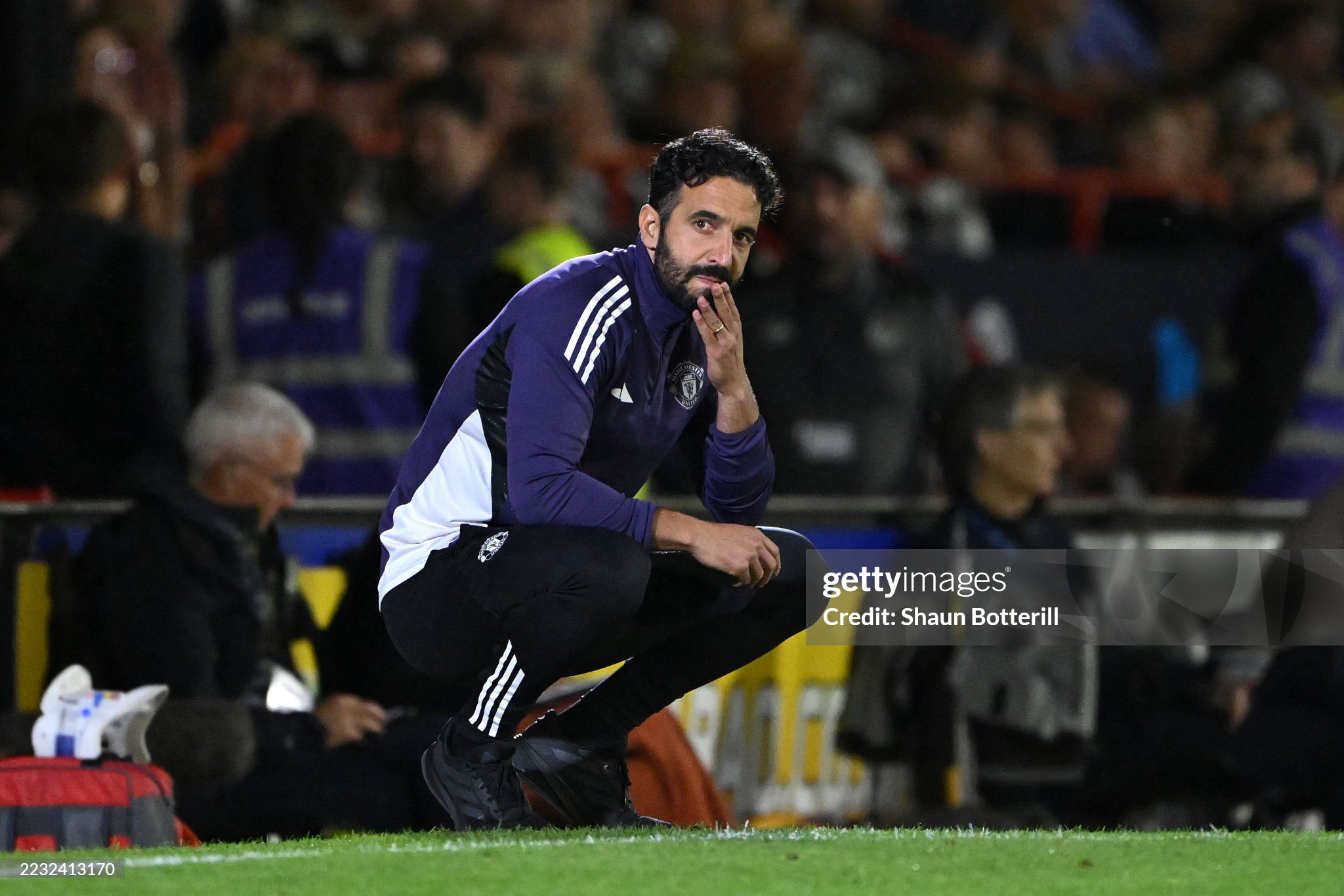
Ruben Amorim arrived at Manchester United with a reputation as one of Europe’s most promising young coaches. His work at Sporting CP, where he famously broke a 19-year title drought, promised a new dawn. However, his tenure at Old Trafford has been anything but a success story. The numbers don’t lie. His win percentage in the Premier League is abysmal, closer to that of a relegation-threatened club than a top-six contender.
The critique of Amorim isn’t just about results; it’s about the very fabric of the team he’s trying to build. His preferred system, a 3-4-2-1, was lauded in Portugal, but it’s clearly not translating to the Premier League. Is it a failure to adapt? Or is it a case of square pegs in round holes? The players seem lost, disjointed, and devoid of a clear plan. The pattern of play is either non-existent or, when it is visible, it’s easily nullified by opposition teams, even those in lower divisions. There is no fluidity, no attacking threat, and no defensive stability. This is on the manager. His tactics, his team selection, and his in-game management have all been found wanting. The honeymoon period is over; now is the time for accountability.
The Players: A Crisis of Quality and Commitment
While the manager must take his share of the blame, the players on the pitch are not blameless. The performance against Grimsby was a shocking display of professional ineptitude. There was a palpable lack of fight, a casual disinterest that is simply unacceptable for a club of this magnitude. Are the players simply not good enough? That’s a valid question. The squad, as it is, appears to be a mismatched collection of individuals rather than a cohesive unit. The recruitment has been questionable for years, and it’s showing on the pitch.
However, beyond the issue of quality, there is a more fundamental problem: is there a lack of commitment? A defeat like the one to Grimsby suggests a profound mental weakness and a disinterest in the club’s fortunes. These are professional athletes earning astronomical wages, and yet they are being outworked, outfought, and outsmarted by players who are, on paper, vastly inferior. The hunger, the desire, the pride of wearing that famous red shirt seems to have been replaced by a sense of entitlement.
The Goalkeeping Conundrum: A Legacy of Poor Decisions
The goalkeeping situation is a perfect microcosm of Manchester United’s mismanagement. The decision by Erik ten Hag to move on from David de Gea has proven to be a catastrophic error. While De Gea was not a “ball-playing” keeper, he was a world-class shot-stopper who consistently bailed out a porous defense. He was a known quantity, a reliable pair of hands.
The decision to replace him with Andre Onana, a “ball-playing” keeper, was a gamble that has backfired spectacularly. Onana’s struggles have been well-documented, with a series of high-profile errors that have cost the team dearly. His “ball-playing” ability has not compensated for his goalkeeping shortcomings. His deputy, Altay Bayindir, has also shown himself to be an unreliable option, making a costly blunder against Arsenal in a recent league match.
The irony is not lost on anyone. The desire to play a specific “style” led to the jettisoning of a club legend and the acquisition of two keepers who have failed to inspire confidence. This is a clear case of a manager prioritizing a philosophy over the practical needs of the team, and it’s a decision that has haunted Manchester United.
Conclusion: Time is Running Out
The issues at Manchester United are numerous and deeply ingrained. The failure in the Carabao Cup is not an isolated incident; it’s a symptom of a much larger malaise. Both the manager and the players are at fault. Amorim’s tactical approach isn’t working, and the players are failing to show the necessary drive and passion. The club’s leadership, from the previous regime to the current one, has made a series of baffling decisions that have left the squad in a state of disarray.
There is no more room for excuses. Time is running out for Ruben Amorim to prove he is the right man for the job. And time is running out for the players to show they are worthy of wearing the Manchester United badge. The proud history of this club demands more. The fans deserve more. The only way forward is a comprehensive and honest reassessment of every single aspect of this footballing institution, before it’s too late.