





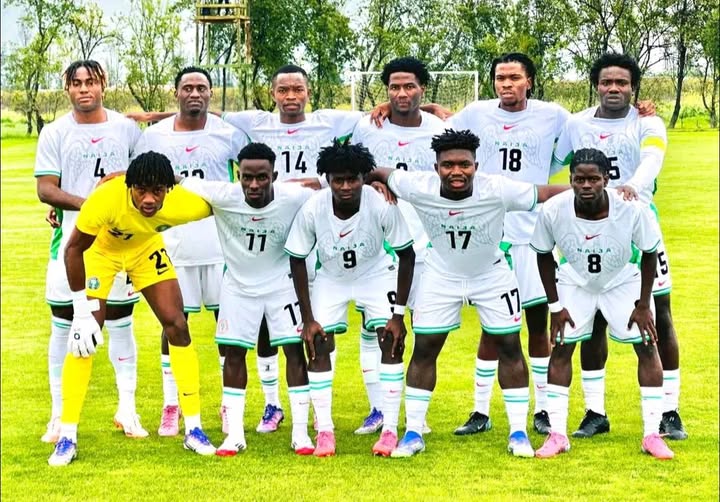
Flying Eagles Soar Over Australia: Decoding Nigeria’s World Cup Prospects After a Dominant Friendly Win
The Final Audition: A Confidence-Boosting Victory and a Glimpse into the Future
Nigeria’s Under-20 side, the Flying Eagles, recently concluded their pre-World Cup preparations with a decisive 3-1 victory over Australia’s U20 team in a closed-door friendly match. This result, achieved in Chile as part of their final tune-up for the 2025 FIFA U20 World Cup, followed a 1-1 draw with the hosts, Chile U20, a few days earlier in Rancagua. The goals for the Flying Eagles were scored by Tahir Maigana, Achihi Oseer, and Charles Agada, providing head coach Aliyu Zubairu with a significant source of encouragement as the team prepares for its opening Group F fixture.
This match was more than just a win; it was a crucial test of the team’s readiness and a final opportunity to fine-tune tactical and personnel adjustments before the global tournament begins. The result against a fellow World Cup participant provides a vital psychological boost and a tangible sign of progress. This analysis will leverage the recent performance to provide a multi-layered examination of the team’s prospects, focusing on the standout players, the complex historical and psychological context of their campaign, and the strategic blueprint of their coaching staff.
Player Breakdown: The Architects of Victory and the Unsung Heroes
The 3-1 win over Australia was a testament to the diverse offensive contributions of the squad. The goals were distributed among three different players, each providing a glimpse into the depth and attacking options available to Coach Zubairu.
The Goal Scorers and Their Impact
Tahir Maigana: A 17-year-old forward, Maigana was credited with the first goal against Australia. His contribution extends beyond a single goal, as he also delivered the corner kick that led to Ahmed Akinyele’s goal in the earlier 1-1 friendly draw with Chile. This highlights his consistent ability to influence the game’s outcome and his valuable set-piece prowess. Maigana plays for Wireless FC in Nigeria and is one of the new additions to the squad, a direct consequence of the coach’s need to find replacements for key players.
Achihi Oseer: A forward for Royal Antwerp FC in Belgium, Oseer scored the second goal. His presence and contribution underscore the international experience within the squad.
Charles Agada: The third goal was scored by Agada, a forward who plays for NK Istra in Croatia. He is one of the fresh names brought into the team, and his goal-scoring performance validates the scouting and selection process undertaken by the coaching staff.
Key Pillars of the Squad
Beyond the goal scorers, the team’s potential lies in its core group of established players who provide a blend of leadership, defensive stability, and creative flair.
Daniel Bameyi: As the team captain, Bameyi is a central figure in the squad and a familiar face from the previous U20 World Cup. He was named to the Best XI at the U-20 Africa Cup of Nations and is known for his leadership and defensive prowess. His experience from the 2023 tournament, where he captained the team to the quarter-finals, makes him an invaluable presence in the backline.
Daniel Daga: Expected to link up with the squad in Chile, Daga is a highly-rated midfielder who plays for Molde FK in Norway. He is described as a “holding midfielder” with a defensive mindset, known for his high passing accuracy and ability to win duels. His integration into the squad will be a significant boost to the team’s midfield control and stability.
Kparobo Arierhi: Labeled a “scoring sensation,” Arierhi plays for Lillestrøm SK, also in Norway, and has been identified by FIFA as “one to watch” at the tournament. He boasts an impressive goal-scoring record of 22 goals in just 15 matches for his former academy in Nigeria. His potential to provide additional firepower from the forward line is a key component of Nigeria’s attacking strategy.
The success of the Flying Eagles in this friendly, with new players stepping up to score, must be viewed in the context of the challenges faced during squad selection. The team was unable to secure the release of several key players based in Europe, including Emmanuel Chukwu of Hoffenheim and Ibrahim Hafiz of Stade Reims, as the FIFA U20 World Cup is not on the official FIFA calendar. This forced Coach Zubairu to make late adjustments and rely on new talent. The fact that these new players delivered in a pressure-filled friendly is a critical demonstration of the team’s depth and a testament to the coach’s ability to adapt his plans. It shows that the victory is not a “false dawn” but a validation of a necessary contingency plan, proving that the squad possesses talent that can rise to the occasion even in the face of unforeseen setbacks.
Expectations vs. Reality: A Storied History and the Path to Glory
The friendly win against Australia is not just about the match itself but about how it positions the Flying Eagles against their own history and the national expectations. The team carries a significant legacy of almost-there performances on the global stage, which shapes the narrative around their 2025 campaign.
A Legacy of Close Calls and High Ambition
Nigeria’s history at the FIFA U20 World Cup is a story of consistent success without the ultimate prize. The Flying Eagles have twice reached the final, in 1989 and 2005, only to finish as runners-up. They also secured a third-place finish in 1985. This track record has established a narrative of a team that consistently reaches the final stages of the tournament but has yet to “break that ceiling” and win the global title.
The team’s recent performance at the U-20 AFCON, where they finished third after a penalty shootout victory over Senegal and a bronze medal win against Egypt, secured their 14th appearance at the global showpiece. This on-field momentum, coupled with a quarter-final finish at the 2023 U20 World Cup, has fueled the ambition of head coach Aliyu Zubairu, who has openly stated his goal is to “surpass Nigeria’s records” at the tournament.
On-Field Momentum Meets Off-Field Scrutiny
The victory over Australia serves as a critical opportunity to shift the public narrative away from off-field controversies and towards the team’s on-field capabilities. In the lead-up to the tournament, the squad’s preparations have been plagued by allegations of favoritism and corruption.
One of the most high-profile instances involved team captain Daniel Bameyi, whose inclusion in a previous squad raised questions about his club, “Yum Yum FC”. Reports questioned the existence of a club by that name, and while a former coach defended the “Yum Yum Academy” as a real entity, the controversy highlighted broader issues of transparency in Nigerian football.
The team’s recent friendly win provides a powerful counter-narrative to these allegations. By showcasing the talent of new and existing players on the pitch, the victory validates the coach’s decisions and demonstrates that, despite the organizational challenges, the quality of the team can shine through. The win helps to build a sense of unity and purpose, essential for a successful tournament campaign, and provides a much-needed morale boost for a squad that has navigated significant external pressure.
Strategy and Coaching: Aliyu Zubairu’s World Cup Blueprint
The victory over Australia offers a practical demonstration of Aliyu Zubairu’s coaching philosophy and his strategic preparations for the World Cup. The friendly was not just a game but a crucial part of his “tactical master plan” to address a known team weakness and prepare for a challenging group stage.
A Tactician’s Pragmatic Approach
Aliyu Zubairu, a “soft-spoken” but “respected tactician,” has a coaching philosophy rooted in detailed analysis and a pragmatic, opponent-specific approach. He has stated that the team must “think about different tactics for our three group opponents” and that the “first step is to study tapes of their recent matches”. This emphasis on pre-match preparation and strategic adaptability is a hallmark of his style, which was honed during his successful coaching career in Nigeria’s domestic league.
Lessons Learned from the Australia Friendly
A key objective for Zubairu since the U-20 AFCON was to “improve attack” and address the team’s “goal-scoring” deficiencies, as they had scored just four goals from open play in the continental tournament. The 3-1 victory over Australia, with goals from three different players, provides concrete evidence that this tactical overhaul has been successful. The win demonstrates the team’s newfound ability to “sharpen their finishing” and “tighten their defence,” which were core objectives for the friendly matches.
The strategic lessons from the friendly win are directly applicable to the diverse tactical challenges of Nigeria’s World Cup group. The Flying Eagles have been drawn in Group F, where they will face Norway, Saudi Arabia, and Colombia. Each opponent presents a different challenge: Norway is known for its “organized structure and disciplined style,” Saudi Arabia for “tactical fluidity and swift attacking transitions,” and Colombia for its “skillful flair and pace”. The victory over Australia, a team from Group D, serves as a crucial blueprint, showcasing that Zubairu’s tactical adjustments can yield a strong attacking performance against a diverse international opponent.
This outcome demonstrates that the coach’s plan to solve the team’s attacking problems is effective and provides a strong foundation for navigating a challenging group stage.
Opponent Date Location Brief Tactical Analysis
Norway September 29 Estadio Fiscal, Talca
Known for an organized and disciplined style of play.
Saudi Arabia, October 2, Estadio Fiscal, Talca
Often surprises with tactical fluidity and swift attacking transitions.
Colombi, on October 5, Estadio Fiscal, Talca
Rely on skillful flair and pace.
Final Verdict: Navigating a Path of Optimism and Caution
The Flying Eagles’ 3-1 friendly victory over Australia is an undeniably positive development in their preparations for the 2025 FIFA U20 World Cup. It provides a much-needed boost in confidence, showcases the effectiveness of Coach Aliyu Zubairu’s tactical adjustments, and demonstrates that the team possesses a diverse range of attacking threats. The performance of new players like Tahir Maigana and Charles Agada is a promising sign of the squad’s depth, particularly given the absence of key players like Emmanuel Chukwu and Ibrahim Ha, who were not released by their European clubs.
However, a complete analysis must acknowledge the lingering questions that remain. Can the team sustain this momentum in the high-stakes environment of the World Cup? Will the tactical fluidity and finishing prowess demonstrated against Australia translate to their encounters with the diverse challenges presented by Norway, Saudi Arabia, and Colombia? Perhaps most critically, can the squad’s on-field performance overshadow the persistent off-field scrutiny, including the allegations of favoritism and the controversy surrounding team captain Daniel Bameyi?
The friendly win provides a solid foundation for optimism, a testament to the talent and dedication of the young players. It suggests that despite the structural challenges and controversies that have plagued Nigerian football, the team is capable of rising to the occasion. The real work, and the true pursuit of the elusive U20 World Cup title, has now officially begun. All eyes will be on the Flying Eagles as they kick off their campaign against Norway on September 29.


One thought on “Nigeria’s U20 Triumph: A Glimpse into the World Cup Journey”